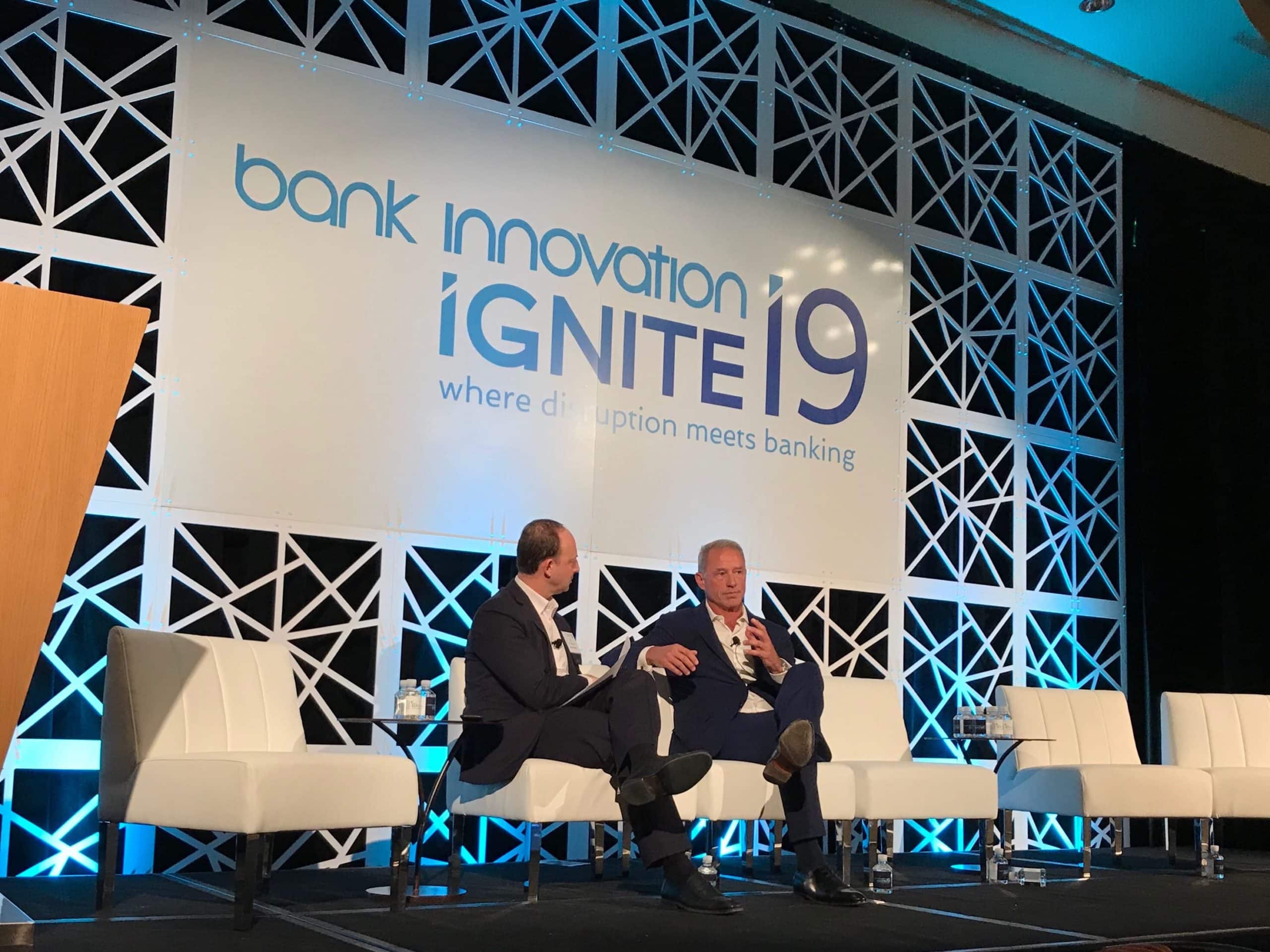
Customers increasingly expect banks and other financial institutions to meet them where they are with full functionality, said panelists at Bank Innovation Ignite 2019 in Seattle on Tuesday.
Alex Carriles, Head of Online Banking at BBVA Compass, said although the bank’s app had won numerous awards for functionality, there were also numerous customer complaints about a lack of functionality.
The bank, he explained, had launched its OpinionLab several years ago as a way for the bank to listen directly to customers and identify pain points. The feedback, he said, guides what his team builds and how it’s presented to the customer.
Carriles said the perceived lack of functionality turned out to be a matter of the customers simply not being able to find the functions they were looking for in the app.
“We realized that we had so much functionality but our customers didn’t know about it,” he said. “So, we went to the lab and started playing with solutions to the question, ‘How are we going to expose all of this functionality to the users?'”
That’s how Carriles’ team came up with the app’s search tool, with text and voice capabilities.
“It is not a digital assistant, because it will not do things for you,” he said. For instance, someone who tells the app they’ve lost their card and ask what they should do is given the suggestion to report the card lost or stolen, but the customer has to go the last mile and tap the button to do so.
“We realized customers were afraid of doing things with assistants for fear that they would do something that they didn’t want to do,” Carriles said. “This way, we take them all the way to the end but they actually, literally, have to press the last button.”
He said by 90 days after launch, more than 40% of all interactions through mobile at BBVA began from that search function.
“Nobody has complained at all that they can’t do something,” he said. “They can complain about other things, but not that they can’t do what they want to do.”
But people also want to do things the way they want.
Philip Ryan, Director of Communication for CCG Catalyst Consulting Group, said the firm’s recent survey of 1,000 banking customers found that when respondents encountered a serious problem, 42% phoned a call center, 30% went to a branch and just 11% chose a self-service option.
“It suggests that more resources need to be put into mobile to allow people to have a more complete customer journey there and solve the problem in the channel of their choice,” he said.
It also suggests when the chips are down, people still want to hear a human voice, Ryan added.
Similarly, Cort O’Haver, CEO of President and CEO of Umpqua Holdings Corporation, said during his Fireside Chat with Bank Innovation CEO JJ Hornblass that while using technology to differentiate is important, “People want people.”
Karen Pascoe, Senior Vice President, Experience Design, Digital Payment & Labs at Mastercard, said her team is always asking what the value of a new product or service is for the consumer as opposed to the value for the financial institution.
“It’s really bringing that outside-in thinking into the organization,” she said.
Mastercard is also increasingly building out usability labs across its global footprint, Pascoe said, in order to determine upfront what users value, how that differs from what the executives value, and how to bring all of that together to remove friction and deliver better experiences.
“Consumers really respond negatively to any friction,” Pascoe said.
Enter artificial intelligence, which is increasingly being used to leverage and organize data to bring quicker answers, at least on simpler inquiries, to more people.
Asked how to balance the ability to provide customer-to-machine interactions with the need, in some instances, for humans to speak to humans, Rob Guilfoyle, CEO of conversational banking startup Abe AI, said it really boils down to the nature of the problem. He said conversational AI may not be the best use case for a complex customer service issue that is hyper-contextual or requires a multi-step workload. He said without the ability to carry out those kinds of tasks quickly and without error, it’s only going to result in loss of trust in the institution.
However, Himi Khan, Senior Vice President, Business Development at AI startup Clinc, said that’s where the market is headed. He said banks are increasingly turning to Clinc because its solution can handle more complex conversations. While trust is an issue and standards have been low, he said those standards are climbing higher.
Khan said the bottom line is if the experience works well and an inquiry is worked out in 6-7 seconds, and the customer is happy, it will make a difference over time in how they perceive conversational banking.
Pascoe said Mastercard’s research shows a growing comfort, particularly among millennials and younger generations, with natural language technologies and using chatbots.
“We’re increasingly seeing that these kinds of experiences will become table stakes,” she said.
Carriles, in the meantime, said there are big opportunities to build better employee-facing AI solutions, particularly if a plurality of customers still want to engage with other humans. He said for inquiries as simple as why an account received an insufficient funds charge, customers have had to talk to as many as 2 or 3 employees because the employees themselves don’t have the complete picture of a customer’s account available.
He said having the ability for an employee to search the entire knowledge base is a “best of both worlds” scenario where customers get the human touch they want while getting the best answer available, quickly.