US Treasury, banks drill down on AML
New regulatory sandbox could allow banks to explore new solutions

Banks are leveraging automation in transactions to weed out suspicious activity from fraudsters, and the U.S. government is taking action to ensure financial institutions can continue testing new anti-money laundering (AML) tactics without running afoul of regulators.
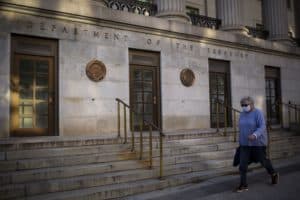
The U.S. Department of the Treasury issued the 2022 National Strategy for Combatting Terrorist and Other Illicit Financing (2022 Strategy), aiming to close legal and regulatory gaps in the country’s AML and counter the financing of terrorism (CFT) framework, according to a Treasury release.
The plan follows increased digitization at financial institutions following the COVID-19 pandemic and the rising levels of digital corruption and fraud, and the strategy will assess whether policymakers should adopt a regulatory “sandbox,” that allows companies to test new digital AML and CFT tools.
“I think a lot of technologies have great potential, but because it’s often driven by machine learning and artificial intelligence [AI], you quickly run into what I would call the ‘black box problem’ for regulators,” Jan Bellens, global banking and capital markets sector leader at EY, told Bank Automation News.
“If you say, ‘Look, here’s what we’ve done, here’s the model we built to eliminate some of the some of the risks inherent in terms of AML financial crime,’ the regulator needs to get comfortable with that. Then as a bank, you need to get comfortable with that it actually works,” Bellens said.
The Treasury’s 2022 strategy recommends:
- Closing legal and regulatory gaps in AML and CFT that fraudsters exploit to anonymously access the U.S. financial system through shell companies and all-cash real estate purchases;
- Making the AML and CFT framework for U.S. financial institutions more efficient and effective with clear compliance guidance, the sharing of information, and fully funding supervision and enforcement;
- Enhancing the operational effectiveness of law enforcement, government agencies and international partnerships to combat illicit finance; and
- Enabling the benefits of technological innovation while mitigating risks, getting ahead of new risk from virtual assets and other new financial products and services.
Financial inclusion
As banks attempt to combat illicit activity, vulnerable communities risk exclusion.
With new payment and remittance schemes for migrants and digital verification identity tools, there is potential that banks “de-risk.” De-risking happens when banks exclude certain accounts deemed to be high risk, which can be a barrier to vulnerable clients, Bellens explained.
“We’ve seen that risk come to real reality in the past,” he said. “I think this is something that requires real attention. If there’s too much of a superficial advisory heavy hand that’s coming in, particularly on those items, you risk that banks de-risk and step away from that offering, rather than embracing it for these vulnerable segments.”
Virtual assets
Keeping tabs on virtual assets presents another challenge for financial institutions. The Treasury is urging the federal government to invest in technology and training to better use virtual asset-related data and AI to combat illicit activity.
“I think the banking system would welcome the further initiatives taken to regulate virtual assets,” Bellens said. “This will give a bit of time for regulators and supervisors to catch up and hopefully to practically regulate. I think this will only be good for the sector as a whole because there were some risks emerging in that [virtual assets] sector.”
Although every bank is at risk of attracting the watchful eye of regulators, challenger banks in particular may find themselves under stricter scrutiny due to their inexperience in combatting financial crimes, according to Bellens.
“There’s a lot more customers onboarding that are obviously new to that particular institution and perhaps also new to the financial system as a whole,” he said.
Bank Automation Summit Fall 2022, taking place Sept. 19-20 in Seattle, is a crucial event on automation and automation technology in banking. Learn more and register for Bank Automation Summit Fall 2022.