AI-driven ‘SaaSpocalypse’ fears overblown, experts say
Companies with data, distribution moats will not be disrupted by AI

SaaS companies have been on a rollercoaster over the past year as AI has moved from experimentation to execution — forcing investors, operators and customers to rethink where value in software actually sits.
The turbulence has been particularly visible in public markets.
SaaS-heavy indices have lagged broader equities in the past year, according to venture capital company Bessemer Venture Fund (BVF). The VC firm’s EMCLOUD index — with companies including CrowdStrike, Datadog, Shopify, Snowflake, nCino, Block and Hubspot — has dropped 14.5% in the past year, while the S&P 500 rose 17.5% in that time, according to a BVF release last month.
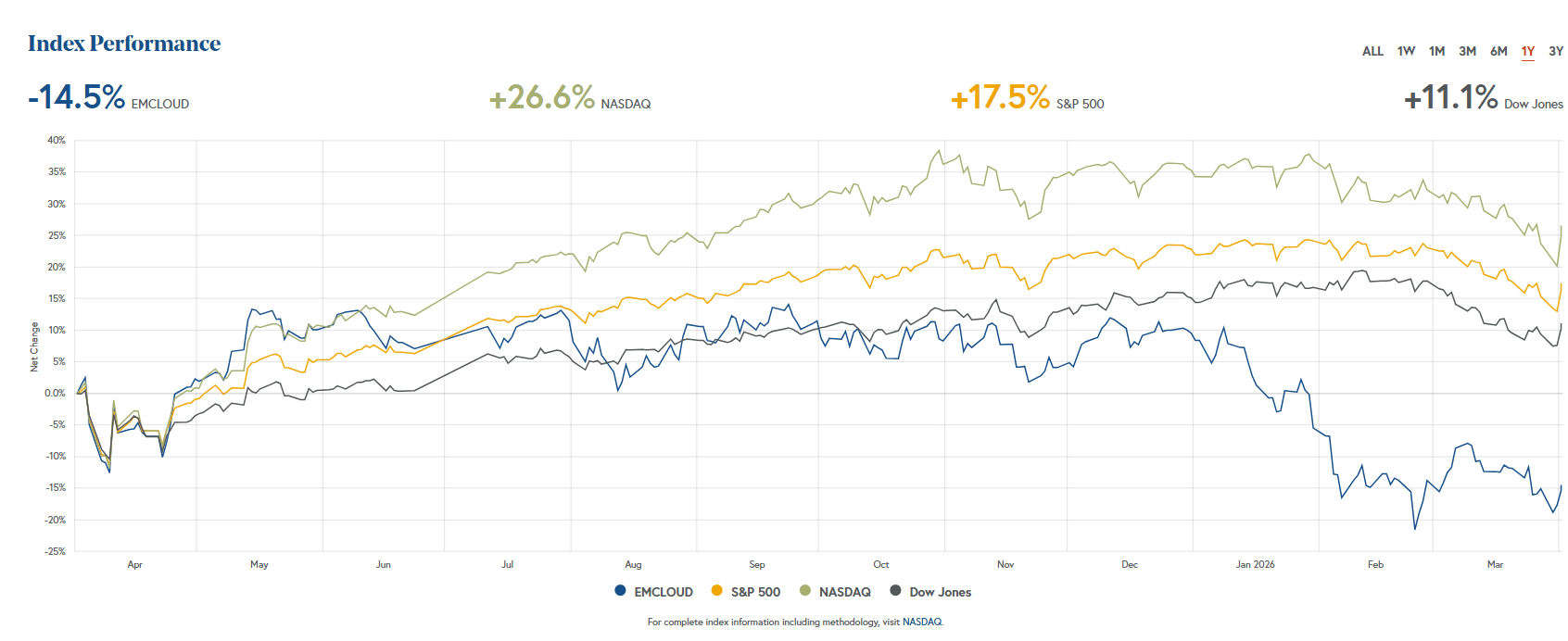
New AI-native tools, particularly from companies like Anthropic, have raised fresh concern about whether traditional software layers can be removed since less expensive agentic AI tools provide similar value, according to the report.
The losses SaaS companies have experienced due to AI innovation over the past year have been called the “SaaSpocalypse” by media outlets including Forbes and TechCrunch.
However, industry leaders from consultancies Kearney, Extend and FactSet told FinAi News that those fears are overstated — and that the real story is not disruption, but rather redistribution of value.
Investors reassess value
The recent selloff in SaaS stocks reflects a deeper uncertainty about how AI will reshape the economics of software, Ben T. Smith IV, head of the communications, media and technology practice at Kearney, told FinAi News.

“Software company valuations are challenged by concerns on impact to cash flows five to 10 years out due to changing strategic moats,” Smith said.
“The real question is where the value gets captured going forward,” he said.
That has led to new criteria for evaluating SaaS companies:
- Does it control the sales channel and enterprise trust;
- Does it own the authoritative data source;
- Does it have proprietary datasets that improve AI performance; and
- Is it embedding AI into core workflows, not just layering it on top.
Companies that meet those criteria are likely to see sustained — even increased — demand, Smith said. Those that don’t may face pressure as AI commoditizes their offerings.
Moat shifting
Andrew Jamison, chief executive of Extend, drew a sharp distinction between SaaS businesses built on public data versus private data.
“If you’re building on top of public information, that can be disintermediated much more easily with AI,” Jamison told FinAi News.
But companies that operate on private, embedded data within enterprise systems are far more defensible, Jamison said.
“We’re connected into card networks and banks and processes. This is private, secure data, not accessible to anyone,” he said. “You can’t just go build over the top of that. There’s a moat.”
And that moat is institutional as well as technical.
“To even participate, your product has to be vetted, go through risk committees and be onboarded as a vendor,” Jamison added. “That creates a very different competitive dynamic.”
Data, distribution define winners
At FactSet, which sits at the intersection of financial data and workflow software, executives see AI as an accelerant of their core business, rather than a disruptor.
“When I think about these new AI interfaces, they’re very powerful,” Kendra Brown, senior director of the banking and sell side research business unit at FactSet, told FinAi News. “But in financial services, the requirements haven’t changed. Clients still need transparency, auditability and outputs that meet strict risk standards.” That means capability is not enough. What matters is how it is integrated into trusted systems.
“What we’re doing is connecting best-in-class models with high-quality data and embedding that into workflows,” Brown said. “That ensures governance, explainability and production-ready quality.”
In other words, AI alone is not the product — the combination of data, workflow and distribution is.
“Companies will win if they have both the distribution and the data,” Brown said. “Otherwise, you just have an AI wrapper.”
Brown described proprietary data as “liquid gold,” the ingredient that differentiates enterprise-grade solutions from generic AI tools.
Despite market volatility and the rapid pace of AI innovation, experts agree that the idea of a “SaaSpocalypse” is overblown, Brown said.
“No one who understands what an SaaS company actually delivers believes the entire layer is going away,” Smith said.
Register here for the FinAi Lending Summit, set for Oct. 7-8 in Las Vegas.