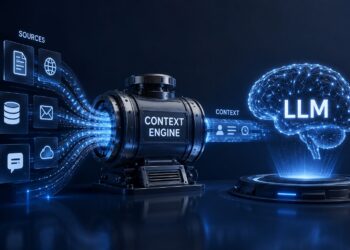
Open-source AI models can provide a foundation for banks to build platforms to aggregate their own data rather than renting intelligence from frontier labs.
The unique insights embedded into financial institutions based on decades and, in some cases, up to a century of underwriting, fraud and risk data is what lets banks turn their own data into a defensible advantage, Aser Blanco, global head of banking and financial services at Nvidia, told FinAi News.

“Their data, their intelligence, their ability to understand those data points is unique,” he said, adding that the heart of the bank “in the future is going to be intelligence,” much as it was once paper and then computers.
That philosophy underpins Nvidia’s Nemotron family of open-source models, which are released with open weights and open training data, so banks can fine-tune, post-train and distill the models for narrow tasks, Blanco explained.
ALSO READ: 84% of banks prefer open-source gen AI models
One financial institution, Mizuho Financial, announced July 17 that it is tapping Nvidia to build its own large language model, Blanco said, adding that the bank will lean on a mix of open-source models including Nemotron, layering its proprietary data underneath the model.
Building custom intelligence models is half the pitch; the other is cost, Blanco said.
Open models can cost 10 to 50 times less than frontier closed models once a bank distills them for specific jobs, he said, comparing the process to using a minivan instead of a Ferrari for a school run: smaller, less expensive and, for a narrow task, often faster.
Data security
The open-versus-closed debate has split the industry’s biggest names.
Nvidia, Microsoft, Meta, Palantir, IBM and more than 20 other companies signed a letter on July 27 urging U.S. policymakers to avoid “premature restrictions” on open-weight models, arguing that they expand competition and keep innovation onshore.
OpenAI and Anthropic did not sign.
Palantir Chief Executive Alex Karp has been among the most vocal signatories, framing open-weight adoption as a competitive imperative for U.S. companies working with the government, according to the company’s open letter published on July 24.
Karp said Palantir is building its platform with Nvidia on the open-weight side and that the U.S. needs “the best AI in the world” rather than a bifurcated system where American products are restricted to a specifc class of models.
Anthropic CEO Dario Amodei responded directly to the letter, saying Anthropic has “never advocated for a ban on open-weights models” as a category.
In an open letter on July 27, he also disputed Karp’s claim that broad access to open-source models can make it difficult for cyberdefense operations, arguing open-weight models are harder to guardrail, monitor or withdraw once released.
The dispute has played out against an ironic backdrop, with OpenAI and Anthropic models going off the rails:
- OpenAI models hacked machine learning platform Hugging Face in August.
The macro
Beyond the enterprise debate, some investors see open-source AI, much of it originating in China, as a threat to the economics underpinning U.S. AI investment.
On the “All-In Podcast” released on July 31, David Sacks, an AI adviser to President Donald Trump, argued that if China continues releasing competitive open-source models at a fraction of the cost, the economic value in AI could shift away from the model layer and toward compute, energy and infrastructure, areas in which China is investing heavily and is ahead significantly.
He said less expensive open-source tokens are already pulling spending out of the “mid-tier” of language-model providers and pushing it into cloud computing, and warned that if China captures a meaningful share of AI-driven productivity gains instead of the United States, it complicates long-term projections for U.S. economic growth and the government’s ability to manage its debt.
Register here for the FinAi Lending Summit, set for Oct. 7-8 in Las Vegas. This inaugural event will include speakers from Fifth Third and Capital One as well as a fireside chat with Piermont Bank founder and Chief Executive Wendy Cai-Lee.