Tech-driven private credit firm Edge Focus is capitalizing on AI and machine learning to enhance investment opportunities in asset-backed securitizations.
Edge Focus, founded in 2017, has identified underwriting as an especially strong area for AI integration in the ABS lifecycle, Chief Executive Elliott Lorenz told FinAi News.
“It’s probably where the greatest leverage exists because, in our view, it’s the most under-invested part of the stack,” he said. “Most decisions are made at origination — who gets the credit, what price, what terms, and ultimately, that gets locked in, and the pool pays out over a series of many months or years.”

Total ABS deal volume reached nearly $1.1 trillion in 2025, up roughly 14% from 2024, according to the SEC.
Any small improvements that AI can provide in terms of predictive accuracy “compounds dramatically” over time, he said.
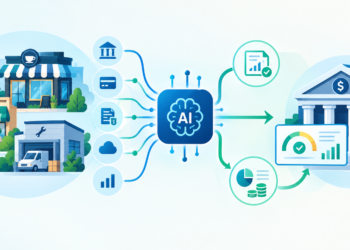
Edge Focus’ proprietary AI-driven underwriting tool, Origin, uses machine learning models to analyze vast datasets to more accurately assess credit risk and predict asset performance.
With Origin, underwriting decisions can be made “at a fraction of the time that a traditional credit committee would normally take,” Lorenz said.
Edge Focus secures loans through its partners’ platforms, and its underwriting tool helps determine which loans to package. The company then facilitates the ABS issuance under its partners’ brands, Lorenz said.
The company generates revenue by licensing Origin to its lending partners, pooling loans into ABS deals and managing investment vehicles for its institutional partners.
Edge Focus, which focuses on consumer loans, helped evaluate tens of billions of applications in 2025 while facilitating more than $2 billion in loan issuance, supporting lenders including Best Egg, Happy Money and Prosper Marketplace, according to a Feb. 19 release.
Flagging distress
AI also provides substantial value by detecting early warning signals of distress in an ABS portfolio, Lorenz said.
Edge Focus helps investors flag these signals with Lens, its AI-driven portfolio analytics and performance monitoring tool.
“Whether it’s the delinquency data or somewhere else, [Lens] helps us manage risk and communicate with investors,” he said.
Ensuring data quality
Edge Focus uses three primary datasets to feed its AI models, Lorenz said, including:
- Bureau data;
- Alternative data, or non-traditional information used to assess risk and predict outcomes; and
- Historical performance data.
Data governance is ultimately the key to effective AI models and machine learning techniques, Lorenz said.
“For example, what one servicer calls 30-days delinquent, does that map correctly to what another servicer may mean by that?” he said. “So, what we’ve done internally is we’ve built standardized ingestion pipelines that enforce these different schema consistencies before any of the data actually touches a model.”
Edge Focus also has validation processes that help it detect unexpected changes in the input data, he said.
Edge Focus believes there are significant opportunities to enhance predictive AI models with alternative data, Lorenz said, also noting the benefits of AI-driven explainability to ease investor concerns and regulatory concerns.
Register here for the upcoming FinAi Lending Summit, set for Oct. 7-8 in Las Vegas.