FIs lead RPA adoption

Financial services are leading the adoption and use of Robotic Process Automation (RPA), driven largely by lending automation, compliance management and hardships program administration.
“Now and Next: State of RPA,” a study released this week by RPA vendor Automation Anywhere, found that 57% of survey respondents said they will increase RPA spending across all industries to 24% or more from just 6% within the year. Enterprise Technology Research conducted the survey of several hundred technology executives and reviewed data from more than 4,000 Automation Anywhere customers in 90 countries.
All eyes are now on financial institutions. Currently, approximately one-third of all RPA deployments are in the financial services sector, the report notes, and banks already have plans to increase their RPA investments.
“Financial services firms have embraced RPA more than any other industry, with approximately one-third of all RPA deployments to date being implemented in that sector,” according to Ken Mertzel, global BFSI leader for Automation Anywhere. “In fact, many banks and other financial services companies have scaled to hundreds and thousands of bots across their organization.”
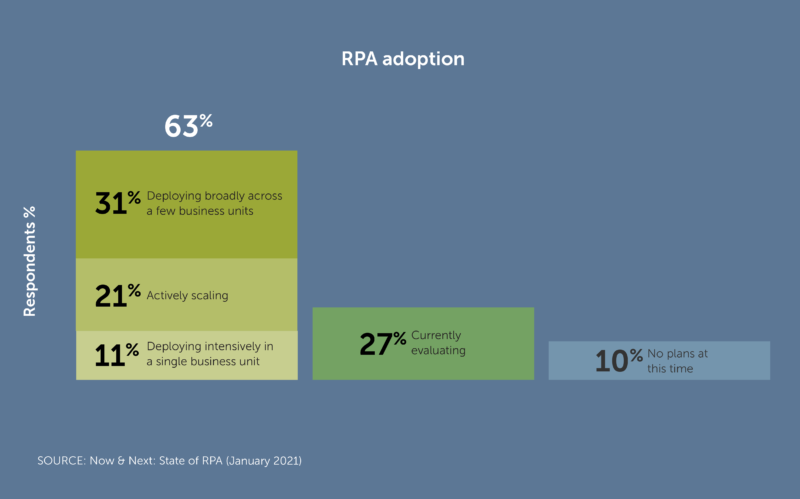
The bot expansion is driven by four use cases, according to the survey:
Lending automation. RPA allows banks to increase the volume of loan applications, specifically for mortgages. Fifth Third, for example, inked a new partnership with online lending fintech Blend to automate parts of its mortgage application process.
CX support. RPA bots help customer service representatives assist customers faster by automating access to customer data from across the organization, speeding interactions and resolving service requests. Regions Bank tapped IBM Watson to improve its call center experience, using the AI tech to route calls to the appropriate department and feed information to agents before they take calls.
Compliance management. RPA streamlines access to internal and external customer data. That, in turn, supports compliance with know your customer (KYC) and anti-money laundering (AML) regulations. The $1.92 trillion Wells Fargo is one bank prioritizing automation efforts for KYC and AML, with one executive saying the bank continues to struggle with speeding up processes for those rules and regs.
Hardships program administration. “RPA enabled banks to administer government-sponsored loans and roll out payment forbearance programs in a matter of days instead of months,” the report notes.
Financial institutions used RPA to stand up automated Paycheck Protection Program (PPP) solutions quickly. But while RPA is fast, banks are treating it as “the literal solution looking for a problem,” according to analyst Nicole Sturgill at Gartner, a tech research firm.
Before deploying RPA, it’s important to document the desired process, rather than automating the current process, Sturgill said, adding that, “if anything changes on any side of the system, if the person responsible for that bit of code does not know about that system change, then there’s no way to fix it. It will break.” In the long run, this may make APIs a better solution for some processes currently being automated by RPA, Sturgill said.
Banks are quick to roll out RPA as a solution because they’ve already found success with it. In fact, many organizations have seen a 50% to 150% return on investment in six to 12 months with RPA, according to the Automation Anywhere study. Across all industries, measurable returns were on average 2.5 times the amount of the overall cost of the RPA investment, the report noted.
Bank Automation Ignite on March 2-3, 2021, is the virtual event for inspiring initiatives and investment in financial services automation. Formerly the Bank Innovation Ignite conference, financial services professionals can discover at this event new use cases and technologies that are accelerating automation in banking. Learn more and register at www.BankAutomationIgnite.com.