Can banks win consumer trust with eco-friendly tech?

Digital banking is going green to win over environmentally conscious consumers.
“In recent history, most of the ways sustainable finance could be accessed was largely through investments or commercial banking, things like social impact bonds, green bonds or mutual funds,” said Ben Stuart, chief marketing officer and head of growth and innovation at Bank of the West, the U.S. subsidiary of BNP Paribas. “The average person didn’t have a way they could get into sustainable finance very easily.”
Almost half of U.S. consumers agree they would definitely or probably change their consumption habits to help the environment, according to Nielsen data, and banks are reacting in turn. Startups and incumbents alike are launching consumer-facing technology designed to appeal to eco-friendly customers.
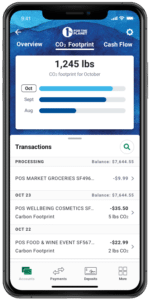
Last week, Bank of the West launched 1% for the Planet, a checking account that uses technology from Doconomy to help consumers track the carbon footprint of their purchases. Doconomy, a startup focused on eco-friendly banking products, built a database of 50 retail categories. The solution is called the Aland Index Solution, which Doconomy describes as “open API, provided as an AWS cloud-based service, accounts for scalability, resilience, redundancy and the security required by banks and financial market participants.” Based on the type of merchant, the technology uses the average carbon footprint for every dollar spent to calculate the overall carbon footprint of consumers’ purchases. If consumers buy a subway ticket, for example, they would see a lighter carbon footprint than for filling up a tank of gas. Doconomy offers a direct-to-consumer card, but its patented technology is available to third parties like banks and payment providers. Doconomy’s partner bank is the Sweden-based Alandsbanken, and Mastercard is its card provider.
The San Francisco-based Bank of the West, which has over $101 billion in assets, locked up an exclusive one-year deal for Doconomy’s technology in the U.S. “We had our eye on [Doconomy] for a couple of years,” Stuart said. The bank announced the account in December and put it through an employee beta in the weeks before the full launch. The account comes with a biodegradable debit card, and 1% of the revenue will go to environmental causes. To start, the money will go to Protect our Winters, a nonprofit dedicated to preserving outdoor winter activities and, in turn, the environment.
Bank of America’s Merrill Edge Self-Directed investment platform, which added AI-based insights in May, shows consumers the environmental, social and governance (ESG) ratings for stocks, funds and overall portfolios. Cory Triolo, a consumer investments digital solutions and experience executive at the bank, told Bank Innovation at the time that their research indicates investors want to invest in social, political or environmental causes. “We now take ESG considerations into nearly all online experiences for finding, validating and monitoring investments in the self-direct space,” he said.
As consumers try to limit their environmental impact, investors are taking note. The Ecosystem Integrity Fund (EIF) is a sustainability-focused venture capital firm that has invested in eco-friendly businesses like Pegasus Solar, OneEnergy Renewables and eMotorWerks. According to Sasha Brown, partner at EIF, the banking industry is trying to keep pace with consumers as they become increasingly eco-conscious.
“In an environment where the government has abdicated its role in environmental protection, consumers are voting with their dollars. Younger generations are especially sensitive to the consequences of environmental degradation,” Brown said. “They are progressively seeking purchasing and investment decisions that are aligned with their ethics and a sustainable future.” A January study from IBM and the National Retail Federation, for example, found that more than two-thirds of “purpose-driven shoppers” will pay up to 35% more for sustainable purchases.
Eco-friendly technology is becoming a valuable industry overall. According to data from Research and Markets, the green technology and sustainability market is set to become a $28.9 billion market by 2024.
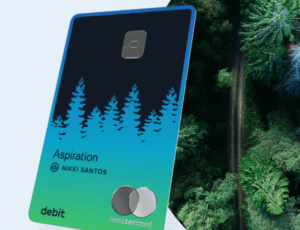
Los Angeles-based banking startup Aspiration, meanwhile, appeals to consumers through a variety of eco-friendly tech initiatives. Similar to Bank of the West’s carbon-tracking tool, the startup’s “Aspiration Impact Measurement” solution allows customers to see their sustainability score as well as the sustainability score of the places they shop. The company, which has raised more than $200 million, is backed by the likes of UBS O’Connor Capital Solutions, DNS Capital, Glenn “Doc” Rivers and Leonardo DiCaprio.
According to Andrei Cherny, Aspiration’s co-founder and CEO, the technology runs on proprietary algorithms that calculate how much carbon different purchases with different brands produce. The startup also offers what it calls “Planet Protection,” the purchasing of carbon offsets for customers’ driving miles, which also runs on proprietary algorithms. “We’re really trying to rethink what a financial institution does and what its products do when they’re built around sustainability and conscience,” he said.
See also: Bank of the West to launch account for eco-friendly customers
Whether this customer-facing technology will be enough to win over eco-friendly consumers is still an open question, especially as big banks continue to fund fossil fuel projects. According to the Banking on Climate Change 2020 report, JPMorgan Chase, Wells Fargo, Citi and Bank of America have been the top four banks in the world when it comes to investing in fossil fuel projects like oil, gas and coal since 2016. BNP Paribas came in 13th and has funded more than $84 billion in fossil fuel projects since 2016, according to the data, but the bank pledged in May to stop accepting new clients with coal-related revenue shares of over 25%.
Chris Allieri, founder and principal of the New York-based branding consultancy Mulberry & Astor, said the new tech initiatives are a step in the right direction, but may be too little too late for consumers asking bigger questions about what their banks are financing. Instead of helping consumers become more eco-friendly, banks would be better served to clean up their financing projects to show consumers they are serious, according to Allieri. “Doing something for the planet is not creating an eco-marketing tool for consumers,” he said.
Bank Innovation Build, which takes place Sept. 9-10 as a virtual experience, is a must-attend industry event for professionals overseeing financial technologies, product experiences and services. Register here.