ATM numbers shrink as cashless trend grows in major markets

As a growing number of consumers swap out cash for mobile or card payments, ATM numbers globally have begun to fall.
U.K.-based consultancy and research firm RBR reported today that the number of ATMs worldwide fell for the first time. It claims global ATM numbers fell by 1% in 2018 to 3.24 million, driven by branch closures and mobile payments growth in four of the five largest markets: China, the U.S., Japan and Brazil.
India was the only outlier among the top five markets. ATM numbers increased there in 2018, although growth is slowing considerably, according to RBR.
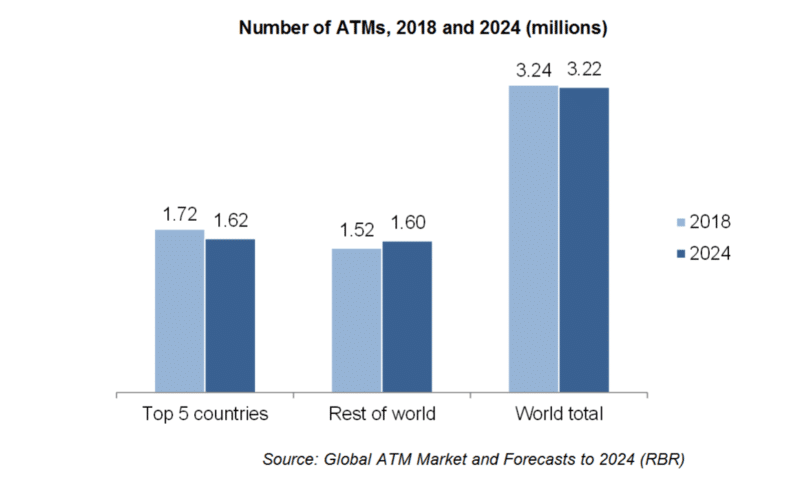 ATM reductions had varying triggers, according to the report. In China, it’s due to the growth of non-cash payments, while branch closures in the U.S. contributed to the drop in ATM numbers. In fact, the number of bank branches in the U.S. has declined steadily since 2014, per research from S&P Global Market Intelligence, and the number of U.S. ATM withdrawals also is falling, according to the Federal Reserve.
Meanwhile, the growth of ATMs in other markets was in part due to financial inclusion initiatives in developing countries across the Asia-Pacific region, the Middle East, Africa and Latin America. RBR predicts that global ATM numbers will fall to 3.22 million by 2024.
To analysts, the ATM reductions are an obvious result of branch reductions in key markets and the growth of mobile banking. Banks also are finding new ways to give consumers access to cash without adding ATMs, said Aite Group research director David Albertazzi. “Banks are finding it cheaper to pay interchange fees to other banks rather than operating their own ATMs,” he said, offering examples of banks that reimburse customers for out-of-network ATM fees.
Despite the ATM reductions, because cash is still an ubiquitous payment method in many markets, it’s unrealistic to forecast the demise of the ATM anytime soon, said Bob Meara, senior analyst at Celent. “Cash utilization remains remarkably resilient in most markets, with a few exceptions (for example, China),” he said, in an email to Bank Innovation. “As long as that remains the case, consumers will continue to value and utilize ATMs.”