Inside Look: Banco Agricola implements Bitcoin for payments
As El Salvador forges ahead with crypto as legal tender, bank enables payments, updates merchant app

When El Salvador in early June passed a law declaring Bitcoin as legal tender, Banco Agricola, the Central American nation’s largest bank, had three months to implement the cryptocurrency as a payment.
The $5.2 billion Banco Agricola immediately began planning its implementation strategy. The U.S. dollar was to remain the primary currency, with Bitcoin to become a payment option.
To understand the bank’s approach, “it’s important to understand a little about El Salvador and what’s happening,” said Sebastian Mora Thiriez, vice president of product and channels development at Banco Agricola. It’s a nation with a population of about 6.5 million, 70% of whom are unbanked; roughly a quarter of its gross domestic product comes in the form of remittances sent from abroad.
A main goal of the Bitcoin law is greater financial inclusion, and the bank acknowledged that a key component of enabling the crypto as a payment is educating the public.
Without much regulatory guidance on the Bitcoin change, Banco Agricola began by consulting on Bitcoin, cryptocurrency and blockchain with its parent company, the $69.1 billion Grupo Bancolombia. Developing a strategy took about two of the three months until Bitcoin was to be implemented.
Bitcoin-enabled digital platform for loan, credit card payments
“We decided that, well, if it’s a digital currency, this should work on the digital platform,” Mora Thiriez told Bank Automation News. Core and digital banking solutions provider Technisys has been Banco Agricola’s partner on that front since 2016. The bank’s objective was to enable Bitcoin payments for loans and credit cards, which the bank would receive converted to U.S. dollars.
The bank uses what Technisys calls its “digital foundation,” including an and engagement layer enabling the bank’s digital channels, explained Ricardo Zuasti, chief product and technology officer at Technisys.
Banco Agricola examined how Bitcoin payments can be made “off chain” via the Lightning Network, a second layer on a Bitcoin or other cryptocurrency blockchain that’s designed to increase efficiency.
For its crypto app, the bank chose New York-based Flexa, a startup that enables payments in cryptocurrencies and immediately converts them to fiat currency. The fintech, founded in 2018, has raised $20.1 million in four funding rounds, according to Crunchbase.
Banco Agricola’s digital banking portal met the Sept. 7 effective date of the Bitcoin law. Customers can view loans, credit cards and the usual transactions, as well as Bitcoin-based payments.
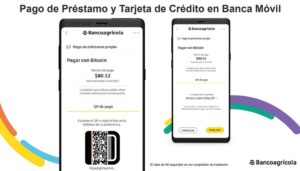
When the user navigates to a credit card or loan, there’s now an option to pay with Bitcoin. If selected, the bank generates a quote for the payment that obtains Flexa’s best rate in the exchange market. A QR code is generated that the customer can use to make a payment from their Bitcoin wallet, and the bank receives the payment “instantaneously” through the Lightning Network. “It would be as if the customer had paid in dollars,” Mora Thiriez added.
The bank’s payment gateway application, Wompi, now allows merchants to accept Bitcoin payments as well, he noted. In addition to payments through the Lightning Network, Banco Agricola is working on accepting payments through the Bitcoin blockchain.
“We’ve been trying — and learning — to create a solution, being El Salvador is the first country to declare Bitcoin as a legal tender,” Mora Thiriez told BAN.
Bitcoin custody
Banco Agricola has no position in Bitcoin since all incoming payments are converted to U.S. dollars. “Right now, we don’t have a wallet or a Bitcoin solution to manage a wallet,” Mora Thiriez said. However, the bank is considering offering customers Bitcoin custody services.
“We said, ‘Well, the first thing is to comply with the law, accept payments in Bitcoin and continue to understand new opportunities in the crypto space,'” he said. Banco Agricola is working to help educate customers — in a population where seven out of 10 individuals are unbanked — about Bitcoin and cryptocurrency before rolling out additional solutions.
In turn, the Salvadorean government launched its own Bitcoin wallet solution, enticing new users with $30 worth of Bitcoin when they join. As of late November, that program had attracted 4 million users, and it’s something of a work in progress as Banco Agricola and others are working on interoperability of systems.
So far, the bank is seeing modest uptake of Bitcoin as a payment. “As we were expecting, the usage has been slow,” Mora Thiriez said.
Meanwhile, he told BAN, the bank’s Grupo Bancolombia parent company is working with cypto exchange and custody provider Gemini on options to buy different cryptocurrencies. New York-based Gemini was founded in 2014 and in November raised $400 million in a series A funding round.
“It’s a space that’s evolving very rapidly,” Mora Thiriez told BAN. “We have to understand the different technologies and what’s happening, and the different opportunities.”
Bank Automation Summit, taking place March 1-2 in Charlotte, N.C., is the first and only event to focus solely on automation in banking. The event will feature the brightest minds from across financial services on intelligent automation strategies and deployment. Learn more and register for Bank Automation Summit 2022.