FinAi News

No products in the cart.

Subscribe
  • News
  • AI News Tool
  • Data
  • Transactions
  • Events
    • FinAi Banking Summit
    • FinAi Lending Summit
  • Podcast
  • WEBINARS
    • Webinar Library
Log In
No Result
View All Result
  • Banking
  • Lending
  • Payments
  • Risk & Security
  • Strategy
FinAi News
  • News
  • AI News Tool
  • Data
  • Transactions
  • Events
    • FinAi Banking Summit
    • FinAi Lending Summit
  • Podcast
  • WEBINARS
    • Webinar Library
BAN PLUS
Log In
No Result
View All Result
FinAi News
No Result
View All Result

5 key tech takeaways from Mastercard CEO

Michael Miebach spoke out this week on fintechs, BNPL, data privacy and super apps

Loraine LawsonbyLoraine Lawson
November 4, 2021
in Strategy
Reading Time: 4 mins read
0
Share on Facebook

Creating the “next big thing” is no longer enough to address an unsolved problem — banks and fintechs also need to ensure that they’re earning customers’ trust.

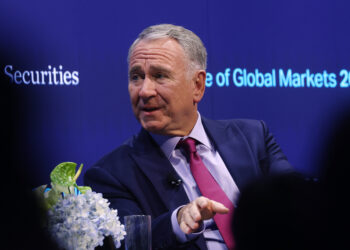
Michael Miebach, chief executive officer of Mastercard  Photograph by Krisztian Bocsi/Bloomberg Mercury

That means ensuring data is kept private and secure, said Mastercard CEO Michael Miebach this week.

Miebach gave the fireside chat at Commerce Summit, a virtual event hosted by venture capitalist firm Commerce Ventures. Barry Rodriques, senior advisor at Boston Consulting Group, spoke with Miebach about the growth in payment options, the role of fintechs in financial services, and the use of technology in lending to those who most need it. Rodriques previously served as CEO of Barclays Cards & Payments and the Barclays Bank Delaware for the $174.1 billion Barclays Bank NA.

Here are five key takeaways from his talk.

Fintechs are friends not foes. Some entrenched financial institutions, particularly in the lending space, look at fintechs as the competition, but that’s the wrong attitude to take, Miebach suggested. “They come into the space of the traditional banks, and they’re seen by some as competitors, and threats,” Miebach said. Fintechs can help banks scale — in fact, they should, he added. “That’s our position, frankly, the best fintech still needs a path to scale, and that’s why we lean in, and they generally been in with us,” he said. “So that’s fundamentally very positive.”

Trust is king. “I think what ruled for a period of time was like whatever is the coolest experience, people will take it on and run with it and love it,” Miebach said. Now, customers want to know they can trust a payments provider to keep their data secure and private. The winning players will be easy and simple to use while solving a problem that no one else has solved — but not at the expense of data privacy, he warned. “I think that trust aspect is one that is settling in as the one thing that doesn’t change with all the volatility and everything else going on,” he said.

Banks want BNPL. The buy now, pay later strategy has caught the interest of banks, Miebach said. He isn’t the only one to say so — Jacqueline White, president of the Americas at Temenos, reiterated this to Bank Automation News recently. When Mastercard offered its installment solution, it simplified processes in the back office for banks, he said. Before BNPL, banks had to merge merchants manually in their consumer finance business, leading to a person literally running from one office to the other to facilitate a loan happening at the checkout counter in the store, he said. “You could do away with that, and the bank would love that.”

Technology can extend lending people who need it. Getting credit to those who most need access to it is a huge pain point, Miebach said, but he contended technology and open banking can help, particularly underwriting tools that leverage AI and transaction data. “Technology today can help that,” he said, even at small and medium-sized enterprises.

“Let’s assume we both run an SME business together and we’re not well served by the existing SME bank and say, you know, we could use our mobile accounts or utility accounts and whatever other data is available to get a more holistic profile, wouldn’t it be great?” Miebach said. “The point is, that is possible, it’s there. And open banking facilitates that.”

Banks are looking at these as tools for financial inclusion yes, but also as a means to expand their lending portfolios by using different data sources to understand loaning to new segments, he said.

“I think that’s good for all of us in a more inclusive economy,” Miebach said.

Super apps for the U.S.? Meh. On the topic of whether the super apps found in Asia could catch on in the U.S., Miebach pointed out that Asia offers a more protected, compartmentalized environment than the U.S. “I don’t think we have that kind of environment here. Tour level of incumbency is, is much higher,” he said. “People are trying things out. We’ll see. I haven’t seen a winning model yet.”

Mastercard [NYSE:MA] was trading at $332.04 at 12: 36 p.m., up .79%, as of market open.

Tags: BNPLfintechMastercardPremium
Previous Post

5 ways AI and automation can boost fairness in small business lending

Next Post

As Plaid network expands, accounts and connected apps change

Related Posts

Strategy

BMO, IBM weigh in on agentic AI-quantum synergy

July 20, 2026
A data graph tracks the movement of stocks on the stock exchange in Germany. Photographer: Bloomberg Creative Photos/Bloomberg Creative Collection
Strategy

Tradeweb, 3forge embedding AI to make trading easier

July 20, 2026
To celebrate the launch of its free financial wellness program Money Roots™, Ally planted a literal money tree in New York City to give away $100,000 – both in person and online – to those who share their money story, ultimately easing financial stress nationwide. Courtesy/Ally
Strategy

Sathish Muthukrishnan leaving Ally

July 20, 2026
Next Post
As Plaid network expands, accounts and connected apps are changing

As Plaid network expands, accounts and connected apps change

EMERGING FINTECH DIRECTORY

Emerging Fintech Directory

The Buzz Podcast

SPONSORED

Build an Antifragile Strategy to Outperform the Market

July 14, 2026

How AI and Product Experts Turn Fuzzy Requirements Into Focused Dev-ready Roadmaps

April 19, 2026

Is Your Technology Supplier There for You?

April 1, 2026

  • About Us
  • Help Center
  • Contact Us
  • Privacy Terms
  • ADA Compliance
  • Advertise

 [wt_cli_manage_consent]

Connect

twitter linkedin podcast podcast podcast
© 2026 Royal Media
No Result
View All Result
  • NEWS
    • All News
    • Banking
    • Lending
    • Payments
    • Risk & Security
    • Strategy
  • AI News Tool [Beta]
  • DATA
  • TRANSACTIONS
  • EVENTS
    • FinAi Banking Summit
    • FinAi Lending Summit
  • PODCAST
  • WEBINARS
    • Webinar Library
  • SUBSCRIBE
  • Log In / Account

Welcome Back!

Login to your account below

Forgotten Password?

Retrieve your password

Please enter your username or email address to reset your password.

Log In

Unlock This Article

Create your free FinAi News account to access this article and stay informed on how AI is transforming financial services including banking, lending, payments, and risk.

Yes, I'd like to receive FinAi News updates, breaking news, and exclusive AI insights for financial services leaders.

Continue Reading with FinAi News Premium - Less than $2/Day

Upgrade to FinAi News Premium for unlimited access to news, insights, trends, and intelligence on how AI is transforming financial services including banking, lending, payments, and risk.
Upgrade to FinAi News Premium Subscription
No Result
View All Result
  • NEWS
    • All News
    • Banking
    • Lending
    • Payments
    • Risk & Security
    • Strategy
  • AI News Tool [Beta]
  • DATA
  • TRANSACTIONS
  • EVENTS
    • FinAi Banking Summit
    • FinAi Lending Summit
  • PODCAST
  • WEBINARS
    • Webinar Library
  • SUBSCRIBE
  • Log In / Account