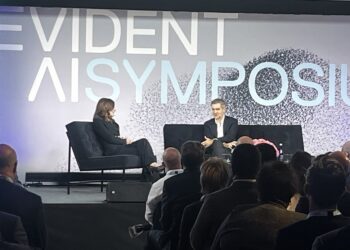
ING Bank’s Marco Eijsackers, is head of CIO office, where he is focused on developing and deploying emerging technologies within the $967 billion bank’s operations.
The Amsterdam-based ING is reaping the benefits of its continued investment in technology and aims to spend less on tech through its optimization and automation of it’s know-your-customer processes, reduced front office staff and branches, and reduced digitalization costs, Chief Financial Officer Tanate Phutrakul said during the bank’s fourth-quarter earnings call on Feb. 1.
The bank is also leveraging AI for coding efficiency and improved customer experience, Eijsackers told Bank Automation News at FinovateEurope in London this week.

Eijsacker, who has been with ING for 17 years, discussed the bank’s plans for AI, branch strategy, balancing between digital and physical interactions, and plans to team up with vendors to develop new technology. What follows is an edited version of the conversation.
Bank Automation News: How has banking changed as the shift to digital grows?
Marco Eijsackers: From an operations point of view, more hybrid working. From a digital transformation point of view, the pandemic was an accelerator. You couldn’t go to a branch, people were at home. So, almost by definition, you reach out through digital channels. If you would pinpoint at least one development, I would say it has been a major move toward digital interactions and banking.
Coming out of the pandemic, we see that customers continue to interact with us digitally. Nearly 70% to 80% of our customers globally interact with us digitally, with certain geographies like Netherlands and Belgium having high digital banking adoption compared to others.
Despite digital interactions remaining sticky, we continue to provide our human touch banking and in-branch services for complex transactions like mortgages, private banking and inheritance-related banking.
There’s always a balance between digital and in-person banking. The app can do almost all functions, but for certain activities, our customers want to have a human touch and we continue to provide it.
BAN: What does digital banking development look like at ING?
ME: There are a lot of things that clients need, but some customers might need a bit more than others. For example, private bank clients have slightly more complex needs, as they might have two or three checking accounts, have a company, perhaps even an account abroad.
Another distinction is how often you need human intervention. For retail customers, their needs are less complex compared to commercial customers. That goes for different kinds of innovation for different kinds of customers. That might be more of a requirement in innovation in workflow management and bill payments compared to demand [for] safer transactions from retail customers.
You see differences in pockets of innovation with corporate clients, which is a bit more complex by definition.
BAN: How would you describe ING’s cloud strategy?
ME: In 2014-15, we said the way forward is something called “cloud,” which nobody knew about. The cutting-edge systems of today are the legacy of tomorrow.
We made cloud our North Star for tech development and have successfully migrated a major chunk of our operations to the cloud. Some of our operations are on the public cloud with Microsoft Azure, while some are on private cloud, which we aim to hold onto for security reasons.
We have found that moving to the cloud has given our infrastructure agility and scalability which has made us ready for the next evolution of technology like AI. Working with partners to develop tech makes more sense to us. I believe in the saying, “You can walk faster when you are alone, but farther when you are together.”
So that is a big debate about AI and how to integrate it in your tech. We are happy working on that because we were already there with the cloud. Cloud helps you keep ahead of new trends.
BAN: How are you approaching gen AI?
ME: We have been working with AI for nearly 10 years when it was called machine learning and big data. We have elements of AI or machine learning in place. But now it’s hyped up because suddenly it’s accelerating.
However, even with excitement around the technology, there are concerns around explainability, security and accuracy. At ING, we are always looking beyond the hype, and we are thinking how to bring gen AI into our systems by making it more secure and accurate while understanding that it’s not the solution for everything.
For us, it can be an improvement for your developer experience, which we highly value because when our developers and engineers build better, faster, and maybe our clients will also see it as we try to improve their experience.
I think we’re in a phase of maturity for AI, perhaps making it more regulated, making sure it’s open, transparent and traceable for real use cases.
BAN: How does ING approach hiring tech and AI talent ?
ME: It’s definitely not easy, otherwise you wouldn’t raise the question. At ING, we are relatively in a good position because we work with new technology like moving to cloud, which attracts talent.
We’re in a place where we have lots of talent in-house and relatively low attrition.
People love working at ING and if they move, they move on to Google or Amazon because they’re always looking for even newer or cooler stuff to work on.
We are capable of attracting talent, but it is a challenge because everybody’s hunting for talent. We need to keep working on advanced tech, not only for our customers but also employees, because that’s a good way of keeping people.
Join us for Bank Automation Summit U.S. 2024 in Nashville, Tenn., on March 18-19! Discover the latest advancements in AI and automation in banking. Register now.