Afterpay moves into US brick-and-mortar retail

Afterpay is heading into brick-and-mortar stores in the United States. The Australian point-of-sale lending company, which launched online in the U.S. in 2018, announced the expansion into physical stores today.
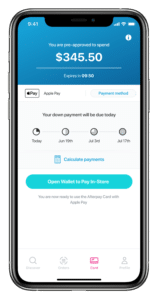
“The Afterpay card — and what we’re bringing to the market — is a virtual, contactless Visa card that is stored either in customers’ Apple or Google wallet,” said Alex Fisher, head of in-store for the U.S. at Afterpay. “There isn’t any technical integration work that needs to be done for this.”
Afterpay hopes to replicate the same success its in-store solution has found in Australia and New Zealand, where the 6-year-old company’s solution accounts for 24% of its underlying sales and is found in almost 40,000 stores. According to David Katz, head of product at Afterpay, in-store point-of-sale lending will help businesses revitalize their retail stores when shoppers return after the pandemic.
The Afterpay card sets a spending limit for consumers, who pay off purchases in interest-free installments over time. The company didn’t disclose the specific factors that determine the credit limit but said the risk engine gets smarter the more often consumers use the card, and it rewards good payment behavior.
In Australia and New Zealand, customers shopping with Afterpay in stores scan a barcode. Katz said the company chose a virtual card over the barcode because existing card rails in the U.S. make for easier merchant integration. The company plans to eventually take the Google Pay and Apple Pay in-store solution global, and Katz said the recent spike in contactless payments should increase the solution’s appeal.
To start, Afterpay’s U.S. in-store option will be available at Forever21, Fresh and Solstice Sunglasses. The online financing option has traditionally helped merchants see bigger basket sizes and decreased cart abandonment, and Fisher said the company is working with retailers to promote the buy-now-pay-later solution in stores to achieve similar results. She added that storefronts, fitting rooms and checkout are all areas where retailers can promote the financing solution.
See also: Afterpay taps Marqeta to fuel US growth strategy
In addition to the U.S., Australia and New Zealand, Afterpay is available in the U.K., where it is called Clearpay. Afterpay reported in May it had more than 5 million active shoppers in the U.S., up from 1.5 million last summer. The company doesn’t charge interest on its point-of-sale loans, instead making revenue on fees charged to merchants. Afterpay also charges late fees that are capped, depending on the purchase total.
Point-of-sale lending is gaining momentum as fintechs and banks alike make their move into the space. “The rate and scale of adoption suggests that this is much more than a flash in the pan — indeed for some it is now the only way they purchase anything online,” Sarah Kocianski, head of analysis and research manager at the fintech consultancy 11:FS, previously told Bank Innovation. Growing popularity, however, comes with increased scrutiny. “Regulators have started asking questions, particularly around the ease with which people can access this method of credit.”
Bank Innovation Build, which takes place Sept. 9-10 as a virtual experience, is a must-attend industry event for professionals overseeing financial technologies, product experiences and services. Register here.