Brazilian challenger banQi is working with a mass retailer to lock in customers

BanQi is getting physical with retailer Via Varejo.
Airfox, a 3-year-old Boston-based financial startup that has raised more than $16 million, wants to enhance consumers’ confidence in digital-only banking through its Brazilian challenger brand banQi. To do so, it is working with Via Varejo, an industry heavyweight that reported $27 billion in revenue last year. The company is using the physical footprint of the retailer as a customer acquisition channel, eliminating the need for physical branches while still offering a human touch when necessary.
Airfox, which declined to comment on its customer numbers, is trying to break through a Brazilian banking environment where a large swath of the population is battling high fees and don’t feel confident using digital banking products. CEO and co-founder Victor Santos told Bank Innovation that Brazilian consumers are saddled with triple-digit APRs and are looking for a route to financial stability.
“When you look at the middle class in Brazil, it’s very different than the middle class in America,” said Santos. “The people in the middle are paying more and more, even for a [checking] account. Don’t get me started on credit, which can be as high as 400% APR.”
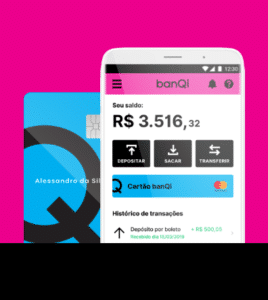
The tie-up with Via Varejo boosts banQi’s credibility among conservative Brazilian customers, who may be wary of straying too far away from incumbent brands. According to the company, Airfox is not spending any money on social media or traditional advertising. Instead, it’s focusing all of banQi’s marketing resources on the retail channel through in-store marketing at Via Varejo stores, which see about 20 million people per month in foot traffic, and through the Via Varejo website. Santos said the retailer is training about 40,000 employees on how to help banQi customers.
According to Global Findex, almost one third of Brazil’s 209 million people are underbanked, an untapped opportunity for digital-only challenger banks. Airfox wants banQi to appeal to older, less tech-savvy customers and, to do so, it’s designed the user interface to be as simple as possible.
Moreover, Airfox wants to encourage more customers to stop using cash — a tall order in a consumer culture that traditionally has shied away from digital payments. McKinsey research indicates 47% of payments in Brazil are cash compared to just 12% using debit card and 18% using credit card. Mobile payments didn’t make the scale.
In August, the company will offer prepaid debit cards from banQi, an upgrade to its current Venmo-style digital wallet where customers can make purchases and pay bills. The debit card rollout is possible through a partnership with Mastercard.
Customers can sign up for banQi with their national identification number and address, and the process takes about three minutes. Unlike the Airfox digital wallet, which the company rolled out in February 2018, the prepaid debit cards work anywhere MasterCard is accepted.
Customers will be able to reload their cards and withdraw cash at Via Varejo subsidiary Casas Bahia stores, of which there are more than 800 in Brazil. Customers also will be able to withdraw cash at certain independent ATMs. Santos said Airfox is hoping to launch direct deposit capabilities for the cards soon to eliminate the need to have to top up cards at Casas Bahia stores.
Meanwhile, like other digital-only banking brands, Airfox is building an ecosystem of financial products. The company is launching life insurance, smartphone insurance and unemployment insurance for banQi customers through a partnership with Zurich Insurance and it’s in the process of developing bill management tools and a loan underwriting product. In addition, it’s got its eyes on international expansion, with plans for launches in other Latin American countries including Argentina, Mexico and Colombia in the next three years.
Of course, Airfox isn’t the only company trying to reach Brazilians wary of big banks. Elo Card and Hipercard also offer prepaid options, and Banco Original, which has been operating since 2011, is another prominent digital-only bank operating in the country.